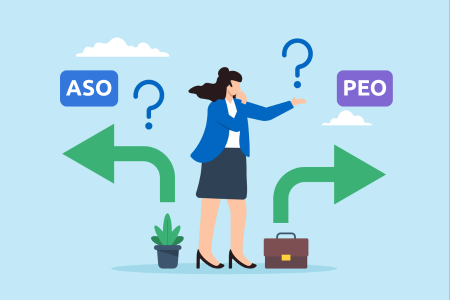
Most business owners researching ASO vs PEO assume the two are basically interchangeable, just different acronyms for outsourced HR. They’re not. The distinction comes down to one legal mechanism, co-employment, and it changes who’s actually on the hook when payroll, taxes, or benefits go wrong.
This guide breaks down exactly how an ASO and a PEO differ structurally, what each one actually does, and how to decide which model fits your company right now.
What Is a Professional Employer Organization (PEO)?
A professional employer organization enters a co-employment relationship with your business. That means the PEO becomes the employer of record for tax and benefits purposes, while you keep full control over daily operations, job roles, and company culture.
The mechanism matters here. A PEO files and remits payroll taxes under its own federal employer identification number (FEIN), not yours. That single detail is what shifts a meaningful share of your compliance exposure onto the PEO instead of leaving it with you.
In practice, a PEO handles payroll processing, tax filing, health benefits, workers’ compensation, and much of your compliance risk in one bundle. You’re not handing over your business. You’re handing over the administrative and legal weight of employing people. Learn more about PEO.
What Is an Administrative Services Organization (ASO)?
An ASO takes the opposite structural approach. It provides payroll processing, HR guidance, and benefits administration, but every filing still runs under your company’s own FEIN. Your business stays the sole legal employer, which means you keep every liability tied to payroll taxes, workplace compliance, and workers’ compensation.
There’s a fiduciary detail worth knowing too: with an ASO, your company remains the sole sponsor of any benefits and insurance coverage, and keeps full fiduciary responsibility for how those plans are managed. The ASO can administer the plan. It can’t absorb the legal accountability for it.
Think of an ASO as a highly capable back office. It handles the paperwork and process, but your company still signs on the dotted line for everything that goes wrong.
PEO and ASO Meaning in One Sentence
If you only remember one thing: a PEO shares your legal risk through co-employment and its own FEIN, and an ASO does not.
ASO vs PEO: The Key Differences Explained
Here’s where the ASO vs PEO comparison gets concrete. Both models can process payroll and manage HR paperwork, but they diverge sharply on legal structure and what you’re actually buying.
Employer of record
A PEO becomes the employer of record for tax and benefits filings under its own FEIN. An ASO never does. Your company remains the legal employer under an ASO arrangement, full stop.
Compliance and liability
With a PEO, employment law risk, workers’ compensation exposure, and tax filing responsibility shift substantially to the PEO. With an ASO, all of that stays with you, even though the ASO is doing the administrative work.
Benefits access
PEOs pool worksite employees from many client companies, which typically unlocks enterprise-level health insurance and retirement plans at rates a single SMB could never negotiate alone. ASOs help you administer whatever benefits plan you already sponsor, but they don’t improve your buying power.
Fiduciary responsibility
A PEO, as co-employer, shares fiduciary duties around benefits administration. An ASO’s client retains full fiduciary responsibility, since the ASO is never the plan sponsor.
Best-fit company profile
PEOs suit businesses that want to offload employer risk entirely, especially fast-growing startups without an HR department. ASOs suit companies with an established HR function, existing broker relationships, or large-group insurance status that just need extra administrative capacity.
PEO vs ASO Pricing
PEOs typically charge based on a percentage of payroll or a per-employee fee that bundles in benefits access, which can look higher upfront but often nets out cheaper once you account for enterprise benefit rates. ASOs generally charge lower per-employee fees since they carry no legal risk, but you’ll still be paying separately for your own benefits, insurance, and compliance management.
Cost, Risk, and Control: The Real Trade-offs
Every ASO vs PEO decision comes down to three variables: how much risk you want to transfer, how much control you want to keep, and how much you’re willing to pay for that transfer.
A PEO costs more per employee on paper, but it buys you shared liability, stronger benefits, and one point of contact for HR problems. An ASO costs less per employee, but every compliance mistake, every workers’ comp claim, and every tax filing error is still legally yours to resolve.
Neither model changes who runs your business day to day. You keep hiring authority, performance management, and culture decisions either way. The difference lives entirely in whose FEIN sits on the filings and who’s legally on the hook when something goes wrong.
How to Decide Between an ASO and a PEO?
Work through these questions in order. Your answers will point you toward the right model faster than any generic comparison chart.
First, ask if you have an internal HR function today. If yes, an ASO can extend that team’s capacity. If no, a PEO gives you an instant HR department.
Second, ask how exposed you are to compliance risk right now. Multi-state hiring, complex benefits, or a thin HR bench all raise your risk profile and push you toward a PEO’s shared-liability model.
Third, ask what your current benefits look like. If your health plan rates are weak because of small group size, a PEO’s pooled buying power usually wins on cost alone. If you already have large-group status through an existing broker, an ASO may be enough.
Fourth, ask how fast you’re scaling. Startups adding headcount quickly benefit from a PEO’s bundled onboarding, payroll, and compliance infrastructure instead of building HR from scratch.
If most of your answers point toward limited risk and existing HR capability, an ASO is probably enough. If they point toward exposure and growth, a PEO is the stronger long-term fit.
Why Businesses Are Leaning Toward PEOs Right Now?
More than 230,000 U.S. businesses currently partner with a PEO, representing about 15% of all employers with 10 to 499 employees, according to the National Association of Professional Employer Organizations. That scale matters for due diligence. It means the co-employment model has been stress-tested across a huge range of industries and company sizes, not just adopted by outliers.
For businesses vetting a specific PEO partner, checking ESAC accreditation is one of the fastest ways to confirm financial reliability, since ESAC independently verifies that a PEO meets dozens of financial, ethical, and operational standards. Pairing that with IRS CPEO certification, which requires a PEO to pass ongoing federal tax compliance audits, gives you two independent checks instead of taking a sales pitch at face value.
How Emerald Labs Helps You Get HR Right?
We’ve worked with startups and SMBs who came to us mid-scale, already tangled in the wrong HR setup for their stage. In our experience building remote and hybrid teams for clients like KeyLeads and Active Elites, the ASO vs PEO decision usually breaks the wrong way when companies pick based on price alone instead of risk exposure and FEIN structure.
Emerald Labs pairs custom software delivery with practical guidance on the HR and staffing infrastructure that supports it, including how PEO and ASO models fit into a broader remote-team strategy. If you’re staffing up while weighing HR outsourcing, that’s exactly the kind of decision our PEO services team helps clients work through, alongside our remote team staffing model built around 100+ engineers and a 97% project success rate.
Ready to stop guessing and get a straight answer for your specific headcount and risk profile? Book a free discovery call with Emerald Labs and we’ll walk through it with you.
The ASO vs PEO decision isn’t about which service sounds more comprehensive. It’s about whose FEIN sits on your payroll filings, how much legal risk you’re willing to keep in-house, and whether your current HR setup can actually absorb it.
If you already have HR leadership and just need administrative bandwidth, an ASO gets the job done. If you’re scaling fast, hiring across states, or running lean without dedicated HR staff, a PEO’s shared liability and pooled benefits will save you more than it costs.
Not sure which side of that line your business falls on? Talk to Emerald Labs and we’ll help you map the right HR structure to your actual growth stage.